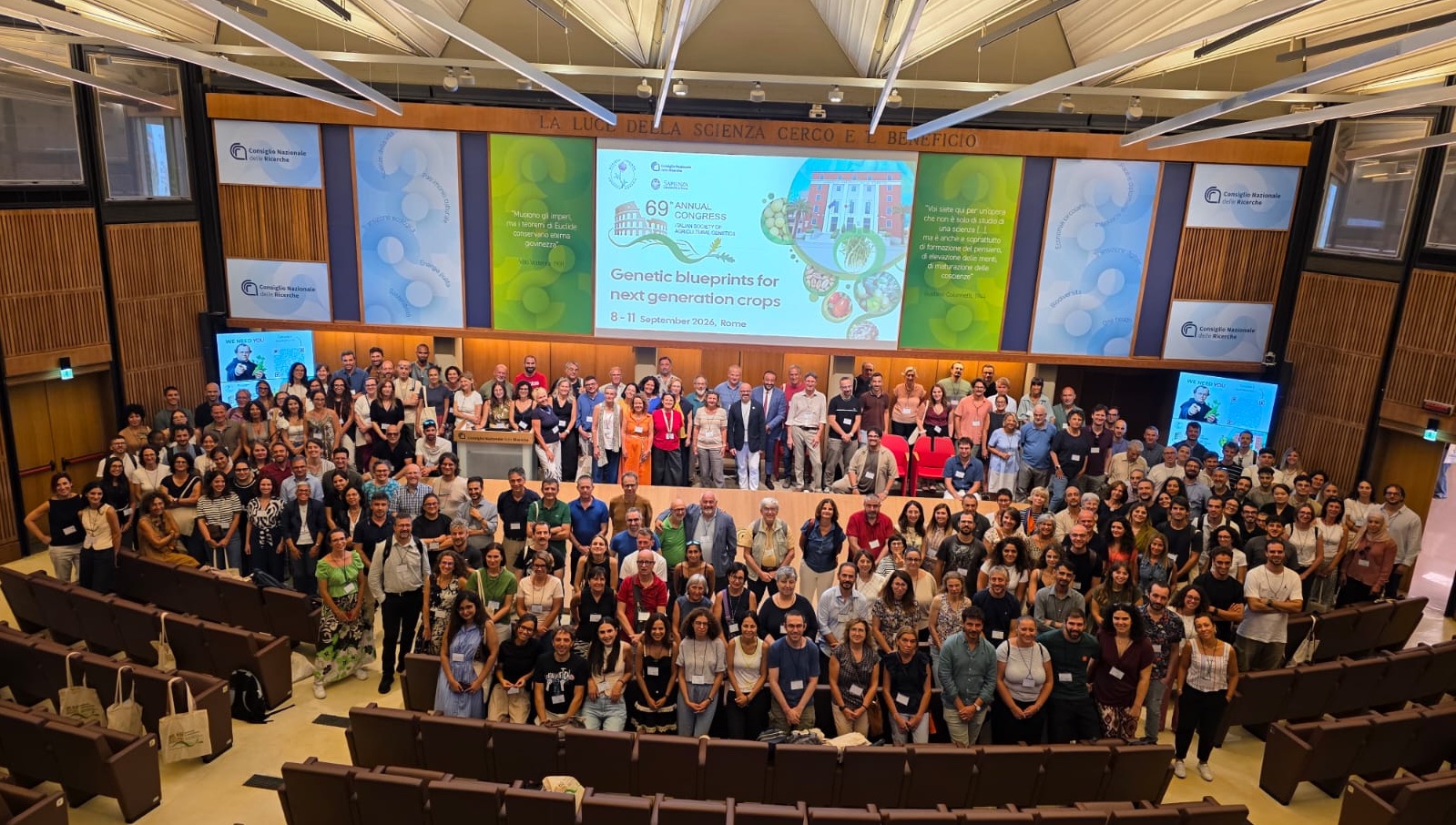
LXIX SIGA Annual Congress
“Genetic blueprints for next-generation crops”
08-11 September 2026
Session 1 – From wild species to crops: de novo domestication and breeding of underutilized crops
Session 2 – Regulation of plant development, architecture, and in vitro regeneration
Session 3 – Emerging strategies and future directions in plant breeding
Session 4 – Harnessing plant potential for food and health
Session 5 – Exploiting plant biodiversity to drive innovative plant breeding
Session 6 – Integrative genomics and regulatory networks for next-generation crop improvement
TUESDAY, SEPTEMBER 09
| 12:00 – 14:00 | Registration and poster setup GROUP I (Sessions 1, 2, 3, 4 and 8 ) |
|---|---|
| 14:00 - 14:30 | Opening ceremony Chairpersons: Stefania Masci, Raffaella Maria Balestrini Welcome addresses by Institutional and Local Authorities |
| 14:30 - 16:30 | Session 1 - From wild species to crops: de novo domestication and breeding of underutilized crops Chairpersons: Stefania Masci, Marco Maccaferri |
| 14:30 – 15:00 | Invited Lecture Hakan Özkan - University of Çukurova, Turkey From wild genomes to future crops: rethinking wheat domestication |
| 15:00 – 15:15 | Usai G., Marino F.G., Simoni S., Rogo U., Colombo V., Castellacci M., Vangelisti A., Giordani T., Natali L., Cavallini A., Mascagni F. Transposable element exaptation shapes gene innovation during wheat evolution and domestication |
| 15:15 – 15:30 | Mazzucotelli E., Giunti M., Castorina G., Guerra D., Desiderio F., Liu C., Ceccato L., Carini E., Bozzoli M., Stefanelli S., Forestan C., Mastrangelo A.M., Marcotuli I., Gadaleta A., Tuberosa R., Maccaferri M., Cattivelli L. Leveraging tetraploid wheat pangenomes to unlock agronomic diversity and resilience of wild and domesticated durum relatives |
| 15:30 – 15:45 | Tekle W.K., Riccucci E., Di Santolo G., Caproni L., Castelletti S., Magris G., Scaglione D., Scalabrin S., Pè M.E., Chanyalew S., Tadele Z., Triacca A., Uauy C., Waweru B., Shorinola O., Dell’Acqua M. Pangenome to accelerate genomic-assisted breeding in teff (Eragrostis tef), an ancient African underutilized crop |
| 15:45 – 16:00 | Delvento C., Giudice G., Guerriero M., Di Marsico M., Pazienza G., Palumbo F., Curci P.L., Giancaspro A., Castorina G., Arcieri F., Losciale P., Tomaselli V., Forte L., Barcaccia G., Aiese Cigliano R., Ricciardi L., Lotti C., Pavan S. Wild and cultivated genomes provide insights into almond evolutionary dynamics and a basis for de novo domestication of wild almond species |
| 16:00 – 16:15 | Moine A., Bonini M.E., Nicotera M., Sportelli G., Boccacci P., Giannetti G., Cunha J., Menéndez Menéndez C., Teszlák P., Nerva L., Chitarra W.,Perrone I., Gambino G., Pagliarani C. A blueprint for selecting stress adapted genotypes in grapevine: from regeneration bottlenecks to in vitro priming strategies |
| 16:15 – 16:30 | General discussion |
| 16:30 – 17:00 | Coffee break and poster viewing (offered by Esse Costruzioni Srl) |
| 17:00 – 18:45 | Session 2 - Regulation of plant development, architecture, and in vitro regeneration Chairpersons: Laura Rossini, Raffaella Battaglia |
| 17:00 – 17:30 | Invited Lecture Maria Von Korff - Max Planck Institute for Plant Breeding Research, Germany Adaptation to thermal stress: decoding barley’s shoot meristem response |
| 17:30 – 17:45 | Unterholzner S.J. Role of brassinosteroid signaling in lateral root cap development |
| 17:45 – 18:00 | Bozzoli M., Sakuma S., Golan G., Makhoul M., Forestan C., Tan K., Raza Khan A., De Sario F., Milner S.G., Sciara G., Liu C., Frascaroli E., Abe F., Hensel G., Feng J.-W., Mascher M., Ammar K., Kojima M., Okamoto M., Tuberosa R., Salvi S., Snowdon R., Maccaferri M., Schnurbusch T. Characterization of GNI2, a gene associated to increased spike fertility in durum and bread wheat |
| 18:00 – 18:15 | Callizaya Terceros G., Lombardo F., Niger A., Prina A., D'Alessandro V., Mare F., Gipli V., Shaaf S., Biswas A., Friel J., Horner D.S., Janiak A., Pouramini P., Salvi S., Vardanega I., Simon R., Hensel G., Hansson M., Rossini L. Unraveling the genetic control of canopy architecture in barley |
| 18:15 – 18:30 | Ciacciulli A., Pennisi F., Caruso M., Augugliaro M., Arlotta C., Licciardello C. Transgene-free genome editing in Citrus via transient Agrobacterium-mediated delivery |
| 18:30 – 18:45 | De Luca V., Fabriani M., Forte V., D'Orso F., Frugis G. Deciphering WOX and TALE regulatory networks to improve in vitro regeneration in lettuce |
| 19:00 - 21:00 | Welcome cocktail - Museum of Classical Art (Gypsoteca), Sapienza University of Rome, Piazzale Aldo Moro 5, Roma |
WEDNESDAY, SEPTEMBER 10
| 09:00 – 10:45 | Session 3 - Emerging strategies and future directions in plant breeding Chairpersons: Silvia Giuliani, Emidio Albertini |
|---|---|
| 09:00 – 09:30 | Invited Lecture Manuel Jamilena - University of Almería, Spain Developing and using TILLING resources for functional genomics and plant breeding in zucchini |
| 09:30 – 09:45 | Mariani A., Bocchini M., Marconi G., Manilia G., Schiappa A., Albertini E. Genomic dissection of a novel resistance source to Tomato Brown Rugose Fruit Virus (ToBRFV) in tomato |
| 09:45 – 10:00 | Palombo V., Puglisi D., Fania F., Esposito S., Angione G., D’Andrea M., De Vita P. Multi-trait genome-wide association study reveals the genetic architecture of yield-component relationships in durum wheat |
| 10:00 – 10:15 | Vieri W., Grinberg N., Belocchi A., Mastrangelo A.M., Maccaferri M., Bozzoli M., Forestan C., Paffetti D., Buti M. Integrating machine learning and GWAS to dissect genotype × environment interactions in durum wheat |
| 10:15 – 10:30 | Dublino R., Carandente V., Sperlì G., Ercolano M. DREM: Teaching AI to uncover the hidden diversity of plant resistance genes |
| 10:30 – 10:45 | General discussion |
| 10:45 – 11:15 | Coffee Break and Poster Viewing |
| 11:15 – 13:00 | Round Table - Il contributo della genetica alle filiere agroalimentari italiane Discussant: Francesca Taranto Participants: Giorgio Gambino - CNR-IPSP Pasquale De Vita - CREA-CI Concetta Licciardello - CREA-OFA Tania Gioia - Università degli Studi della Basilicata Salvatore Parlato - Diagram Group Mario Marino - FAO Silvia Giuliani - Assosementi |
| 13:00 – 14:30 | Lunch Break |
| 14:30 – 16:15 | Session 4 - Harnessing plant potential for food and health Chairpersons: Roberta Paris, Vincenzo D'Amelia |
| 14:30 – 15:00 | Invited Lecture Dominique van der Straeten - Ghent University, Belgium Agriculture under global climate change: tackling challenges of stress resilience and nutritional losses |
| 15:00 – 15:15 | Calderini O., Alagna F., Baldoni L., O'Connor S., Osbourn A., Rodriguez-Lopez C.E. Integrative analysis and co-expression networks uncover the biosynthetic machinery of iridoids and triterpenoids in olive (Olea europaea L.) |
| 15:15 – 15:30 | Paolo D., Confalonieri M., Rossi C., Tamasi G., Megna S., Locatelli F., Galbiati M., Preite C., Sparvoli F., Cominelli E. Genome editing of GMSULTR3;3 by CRISPR/Cas9 provides a new strategy for managing phytic acid accumulation in soybean |
| 15:30 – 15:45 | Marcotuli I., Caranfa D., Colasuonno P., Giove S.L., Gadaleta A. Deciphering β-glucan biosynthesis in wheat and its wild relatives using advanced genetic tools |
| 15:45 – 16:00 | Esposito S., Liva M., Pasquariello M., Puglisi D., Paris R., Martinelli T., Magris G., Pecchioni N., Morgante M., De Vita P., Bassolino L. A chemotype B genome assembly identifies a DIRIGENT locus on chromosome 10 associated with silydianin-rich silymarin in milk thistle |
| 16:00 – 16:15 | General discussion |
| 16:15 – 17:45 | Poster Discussion GROUP I (Sessions 1, 2, 3, 4 and 8) |
| Coffee break | |
| 17:45 – 18:30 | Poster Dismount GROUP I (Sessions 1, 2, 3, 4 and 8) |
| 17:45 – 19:30 | SIGA General Assembly |
THURSDAY, SEPTEMBER 11
| 08:30 – 09:00 | Poster setup GROUP II (Sessions 5, 6 and 7) |
|---|---|
| 09:00 – 11:00 | Session 5 - Exploiting plant biodiversity to drive innovative plant breeding Chairpersons: Eleonora Cominelli, Francesco Cellini |
| 09:00 – 09:30 | Invited Lecture Mats Hansson - Lund University, Sweden Exploiting historic barley mutants to drive next-generation crop improvement |
| 09:30 – 09:45 | Forestan C., Ens J., Pancaldi L., Bozzoli M., Gallizioli B., Colombo M., Mazzucotelli E., Faccioli P., Giorgioni M., Fengler K., Llaca V., Wiebe K., Esposito S., Pirona R., Toegelová H., Moretti G., Scaglione D., Tafuri A., Farooq Muhammad A., De Vita P., Curci P.L., Faris J., Sonnante G., Pecchioni N., Xu S., Chantret N., Sen T., Bassi F.M., Walkowiak S., Šimková H., Ranwez V., Distelfeld A., Chawla H.S., Gadaleta A., Akhunov E., Baum M., Copetti D., Rusholme-Pilcher R., Hall A., Spannagl M., Ceriotti A., Zastrow-Hayes G., Sestili F., Masci S., Morgante M., Cattivelli L., Salvi S., Tuberosa R., Pozniak C., Maccaferri M. Exploring the tetraploid wheat pangenome and pantranscriptome |
| 09:45 – 10:00 | Cozzi P., Testone G., Russo C., Paolo D., Cominelli E., Galbiati M., Losa A., Sala T., Gaiti A., Avite E., Pozzi C., Sparvoli F. Comprehensive mutation discovery in an EMS-based common bean TILLING platform using optimized whole-genome sequencing |
| 10:00 – 10:15 | Sabato R., Marzario S., Morante V., Verrastro C., Placido G.P., Logozzo G., Pavan S., Taranto F., Nagel K.A., Di Vittori V., Bellucci E., Bitocchi E., Papa R., Gioia T. Reducing complexity, preserving diversity: a validated global lentil core collection for genomic and phenotypic analysis |
| 10:15 – 10:30 | Biselli C., Fricano A., Giacosa S., Garavelloni S., Valentini F.M., Epifani A.M., Espinosa-Roldán F.E., Rolle L.G.C., Crespan M. High-throughput SPET-based genotyping and large-scale phenotyping to mine the genetic architecture of berry texture and seed development in grapevine |
| 10:30 – 10:45 | Castellacci M., Usai G., Cavallini A., Natali L., Mascagni F., Giordani T. Transposable element-induced structural variations in Ficus carica: a Genome-Wide Association Study revealing key determinants of fruit quality |
| 10:45 – 11:00 | General discussion |
| 11:00 – 11:30 | Coffee Break and Poster Viewing |
| 11:30 – 13:15 | Session 6 - Integrative genomics and regulatory networks for next-generation crop improvement Organized by Next Generation SIGA Group Chairpersons: Anna Bertoncini, Matteo Martina |
| 11:30 – 12:00 | Invited Lecture Agnieszka Golicz - Wageningen University & Research, The Netherlands Accessing crop genetic diversity with pangenomics and AI |
| 12:00 - 12:15 | Luzzi I., Placentino A.M., Javier Ordoñez Trejo E., Esposito S., Dilmé Capó J., Radio S., Aiese Cigliano R., Batelli G., Varotto S. Chromatin-mediated transcriptional memory shapes responses to recurrent drought in tomato |
| 12:15 - 12:30 | Cimmino L., He X., Smimmo R., D'Alessandro R., Cirillo V., Docimo T., Termolino P., Santoro V., Piccinelli A.L.., D'Amelia V., Carputo D., Benhamed M., Aversano R. Multi-layer regulatory profiling of salt tolerance in the wild potato relative Solanum commersonii |
| 12:30 - 12:45 | Amato A., Bellon O., Santiago A., Pose D., Matus J.T., Zenoni S. Toward the definition of the intra-family transcriptional network of NAC factors governing berry ripening in grapevine |
| 12:45 - 13:00 | Di Guardo M., Cannizzaro G., Seminara S., Caycho E., Luca L.P., Catalano C., Giuffrida A., Cortese M., Las Casas G., Russo R., Di Silvestro S., Caruso M., Ferlito F., La Malfa S.G., Distefano G., Castanera R., Gentile A. A sweet orange pangenome reveals novel insights on the genetic regulation of anthocyanins accumulation in pigmented orange |
| 13:00 - 13:15 | Tagliabue A.G., Friel J., Chiozzotto R., Baccichet I., da Silva Linge C., Calastri E., Biffi G., Zaracho N., Gattolin S., Micali S., Eduardo I., Bassi D., Rossini L., Cirilli M. Beyond-the-reference genomics reveals regulatory structural variation controlling fruit maturity timing in peach |
| 13:15 – 14:45 | Lunch Break |
| 14:45 – 16:15 | Poster Discussion GROUP II (Sessions 5, 6 and 7) |
| Coffee Break | |
| 16:15 – 17:45 | Round Table – Proteggere le innovazioni: brevetti, IPR e privative vegetali a confronto Discussant: Massimiliano Beretta - Panora Seeds Participants: Emidio Albertini – SIGA Silvia Giuliani - Assosementi Corrado Lamoglie - CREA Daniele Manzella - FAO Francesco Mattina - CPVO Valentina Predazzi - Società Italiana Brevetti |
| 20:30 | Social Event - Cloister of San Giuseppe de Merode, Via San Sebastianello 3, Roma |
FRIDAY, SEPTEMBER 12
| 09:00 – 09:30 | Poster dismount GROUP II (Sessions 5, 6 and 7) |
|---|---|
| 09:30 – 10:15 | SIGA Young Researcher Award 2026 Dedicated to Carlo Jucci Chairpersons: Stefania Masci, Daniele Rosellini Gaccione L. Graph-based pangenomes and pan-phenome provide a cornerstone for eggplant biology and breeding Puglisi D. Genomic prediction models for morpho-phenological traits in durum wheat based on Vrn, Ppd, and Rht alleles Ottaviani L. A loss‑of‑function of ZmWRKY125 induced by CRISPR/Cas9 improves resistance against Fusarium verticillioides in maize kernels Award ceremony |
| 10:15 – 12:15 | Session 7 - Improving the utilization efficiency of key resources, water and nutrients for crop productivity Chairpersons: Francesco Sunseri, Laura Toppino |
| 10:15 - 10:45 | Invited Lecture Gabriel Krouk - National Center for Scientific Research, Montpellier, France Nitrogen signaling interactions (NxP) and a new kind of GWAS |
| 10:45 - 11:00 | Misale L., Mauceri A., Vadalà V., Puccio G., Giuliano A., Gabriele C., Liuzzi S., Gaspari M., Abenavoli M.R., Mercati F., Sunseri F. Integrated transcriptomics and proteomics tomato and eggplant responses to limited nitrogen availability |
| 11:00 - 11:15 | Giudice G., Haider I., Conti L., Di Leo G., Losciale P., Pavan S. Deciphering almond response to water deficit through integrated transcriptomic, morphological, and physiological profiling |
| 11:15 - 11:30 | Massafra A., Ugolini L., Bassolino L., Malaguti L., Pecchioni N., Righetti L. Evaluation of Eruca sativa protein hydrolysate as a plant biostimulant for growth and stress resilience |
| 11:30 - 11:45 | Fasani E., Cozzaglio S., Visioli G., Furini A., DalCorso G. Genetic and functional evolution of zinc transporter MTP1 underlies adaptation to distinct edaphic conditions in the Brassicaceae family |
| 11:45 - 12:00 | Punzo P., Esposito S., Scalzi N., Ruggiero A., Costa A., Mango T., Grillo R., Petrozza A., Cellini F., Cardi T., Carriero F., Nicolia A., Grillo S., Batelli G. Signal attenuation under stress: role of the AFP family in the regulation of tomato drought tolerance |
| 12:00 - 12:15 | General discussion |
| 12:15 – 12:30 | Closing Ceremony Chairpersons: Stefania Masci |
Keywords index
| - | |
| -omics analysis | 4.02 |
| A | |
| ABI5 INTERACTING PROTEINs | 7.06 |
| abiotic | 6.07 |
| abiotic stress | 5.08, 5.14, 5.17, 5.18, 5.19, 6.20, 7.12 |
| abscisic acid | 7.06 |
| Aegilops | 4.04 |
| agrivoltaics | 6.15 |
| Agrobacterium rhizogenes | 3.07 |
| agrobiodiversity | 5.12, 5.51, 8.13 |
| agrobiodiversity conservation | 4.11 |
| agroecosystems | 1.07 |
| agroforestry | 3.13 |
| agronomic management | 4.07 |
| agronomic trait loci | 6.13 |
| alfalfa | 6.10 |
| alien gene transfer | 5.17, 5.19 |
| alien introgression | 5.14 |
| Allele Specific PCR (ASP) | 1.12 |
| allelic variation | 5.39 |
| Allium cepa L | 5.53 |
| allometric allocation | 2.03 |
| almond | 1.05, 5.25, 7.03 |
| altered gravity | 2.22 |
| AM fungi | 7.14 |
| anther indehiscence | 2.09 |
| anthesis | 2.29 |
| anthocyanin pigmentation | 2.15 |
| anthocyanins | 4.15, 4.19, 6.09 |
| antioxidant activity | 5.52 |
| antioxidant response | 6.03 |
| apomixis | 2.10 |
| apospory | 3.09 |
| apple | 2.25 |
| apricot | 5.24 |
| Arabidopsis thaliana | 2.29 |
| ARF | 2.13 |
| Artificial Intelligence | 3.16, 8.03 |
| arundamine | 4.17 |
| Atropa belladonna | 6.20 |
| auxin | 2.13 |
| B | |
| barley | 2.11, 3.19, 5.01, 5.48 |
| barley landraces | 5.39 |
| barley mutants | 3.21 |
| bell pepper | 2.08 |
| berry ripening | 6.04 |
| berry texture | 5.05 |
| beta-carotene | 5.22 |
| beta-glucan | 4.04 |
| bi-parental mapping | 3.18 |
| bioactive compounds | 4.06 |
| biodiversity | 5.20, 5.28 |
| biofortification | 4.03 |
| biosynthetic pathway | 4.17 |
| biotic stress | 5.08, 5.13 |
| biparental linkage analysis | 3.12 |
| blood orange | 4.15, 6.05 |
| Brassica rapa subsp. sylvestris | 2.29 |
| brassinosteroid signalling | 2.02 |
| brassinosteroids | 2.12, 2.16 |
| bread wheat | 8.01 |
| breeding | 1.11, 3.18, 3.20, 5.11, 5.20, 8.04 |
| broccoli rabe | 8.11 |
| broccoli-raab landraces | 5.21 |
| broomrape | 5.22 |
| browning | 4.13 |
| BSAseq | 6.14 |
| C | |
| Camelina sativa | 4.09 |
| candidate genes | 5.29, 5.42 |
| Cannabis sativa | 5.26, 8.04 |
| Cannabis sativa L. | 5.50 |
| canopy architecture | 2.04 |
| Capsicum annuum | 5.23 |
| Capsicum annuum var. glabriusculum | 5.56 |
| carbon remobilisation | 5.14 |
| carotenoid cleavage dioxygenases | 6.24 |
| carotenoids | 4.08 |
| Cas9/RNP complex | 2.25 |
| cellular plasticity | 2.27 |
| characterization | 5.11, 5.15 |
| Chardonnay | 2.07 |
| chickpea | 7.19 |
| chlorogenic acid | 4.13 |
| chromatin remodeling | 6.17 |
| chromosome-level de novo genome assembly | 1.10 |
| Cichorium spp | 2.24 |
| cisgenesis | 2.28, 3.08 |
| Citrus | 4.19 |
| Citrus limon | 5.38 |
| Citrus sinensis | 4.15, 6.05 |
| climate adaptation | 3.04, 5.47 |
| climate change | 5.20 |
| climate resilience | 1.07, 8.03 |
| clinostat | 2.22 |
| CoCas9 | 8.07 |
| cold | 4.19 |
| cold storage | 4.15 |
| coleoptile length | 2.21 |
| common bean (Phaseolus vulgaris L.) | 5.03 |
| comparative genomics | 6.11, 6.12 |
| complementation test | 4.10 |
| complex plant genomes | 5.44 |
| composite cross-population | 5.36 |
| computational genomics | 3.05 |
| conservation | 5.15 |
| conservation genetics | 8.14 |
| core collection | 5.04 |
| CRISPR | 8.07 |
| CRISPR-Cas | 4.18 |
| CRISPR-Cas9 gene editing | 2.04 |
| CRISPR/Cas | 2.20, 3.06 |
| CRISPR/Cas system | 2.18 |
| CRISPR/Cas9 | 2.05, 2.08, 2.15, 2.16, 3.07, 8.04 |
| crop improvement | 5.01 |
| crop modelling | 3.11 |
| crop stress detection | 8.03 |
| crop wild relatives | 5.09, 6.09 |
| Cucumis melo | 1.09 |
| Cucurbita maxima | 4.08 |
| Cucurbita pepo | 3.01 |
| curcumin | 4.12 |
| cuticle | 7.16 |
| Cynara cardunculus subsp. scolymus (L.) | 5.12 |
| D | |
| DArT array | 5.55 |
| ddPCR | 8.17 |
| ddRADseq | 5.53 |
| de novo domestication | 1.05 |
| deep learning | 3.05, 3.15, 3.16, 6.01 |
| development | 2.23 |
| differentially expressed genes (DEGs) | 6.08 |
| digital phenotyping | 3.14 |
| disease resistance | 1.03, 3.12, 3.15, 5.45 |
| disease resistance genes | 5.57 |
| Dittrichia viscosa | 4.06 |
| diversity | 1.08 |
| DNA barcoding | 1.12 |
| DNA integrity | 5.27 |
| DNA methylation | 8.02 |
| DNA methylome | 6.21 |
| DNA-free genome editing | 2.17, 2.25 |
| domesticated emmer | 1.03 |
| domestication | 6.09 |
| double-pruning | 8.06 |
| Downy Mildew Resistance 6 | 8.10 |
| DRO1 | 7.07 |
| drought | 5.48, 6.07, 7.16, 7.18 |
| drought adaptation | 5.49, 7.12 |
| drought priming | 8.15 |
| drought resilience | 5.34, 7.15 |
| drought stress | 5.32, 5.39, 6.18, 7.08, 7.19, 8.10 |
| drought stress memory | 6.02, 6.17 |
| drought tolerance | 1.03, 5.07, 5.18, 5.19, 5.29, 7.09 |
| dual-RNAseq | 1.13 |
| Duplex-Specific Nuclease (DSN) | 5.44 |
| durable resistance | 3.08 |
| durum wheat | 2.16, 2.19, 3.03, 3.04, 3.08, 3.15, 4.07, 4.14, 5.08, 5.13, 5.35, 5.45, 5.49, 5.55, 6.23, 7.12, 8.16 |
| E | |
| E3 ubiquitin ligase | 7.09 |
| eco-physiology | 8.15 |
| ecogeographic sampling | 5.09 |
| EGFP transient expression | 2.17 |
| eggplant | 4.13 |
| electromagnetic waves | 8.01 |
| embryogenic callus | 2.17 |
| embryogenic niches | 2.27 |
| EMS mutations | 3.01 |
| enzyme discovery | 4.02 |
| epigenetic signature | 8.15 |
| epigenetics | 6.02, 6.07, 6.17, 6.18 |
| Eragrostis tef | 1.04 |
| Eruca sativa | 1.10 |
| ex situ conservation | 5.12, 8.14 |
| explainable AI | 6.01 |
| Extracellular vesicles | 6.19 |
| F | |
| feruloyl esterase | 8.12 |
| Ficus carica | 5.06 |
| Flavescence dorée | 2.07 |
| FLC gene | 4.09 |
| floral transcriptomics | 6.12 |
| floret development | 2.03 |
| floret fertility | 2.03 |
| flower and fruit development | 3.01 |
| flowering time | 4.09 |
| frost resistance | 5.30 |
| fruit | 2.23 |
| fruit morphology | 5.10 |
| fruit pigmentation | 8.09 |
| fruit quality | 3.01, 5.06, 5.23, 5.36 |
| FST | 5.55 |
| full length cDNA sequencing. | 7.04 |
| functional foods | 4.08 |
| functional genomics | 5.03, 6.25 |
| functional variant prioritization | 6.13 |
| fungal diseases | 3.08 |
| Fusarium Head Blight | 6.23 |
| G | |
| G × E Interaction | 3.20 |
| GA sensitivity | 2.21 |
| GATA7-like genes | 2.16 |
| GBLUP | 3.20 |
| gene bank | 5.15 |
| gene editing | 4.03, 8.10 |
| gene expression | 5.27, 7.17 |
| gene identification | 5.01 |
| gene innovation | 1.02 |
| gene regulatory network | 6.04 |
| Genebanks | 5.31 |
| genetic architecture | 3.03, 5.47 |
| genetic characterization | 5.12, 8.08 |
| genetic diversity | 4.11, 5.01, 5.02, 5.24, 5.25, 5.41, 5.55, 6.11, 8.14 |
| genetic resistance | 3.02, 5.33 |
| genetic resource | 5.30 |
| genetic resources | 1.07, 5.15, 5.31, 5.54 |
| genetic traceability | 5.50 |
| genetic transformation | 2.10 |
| Genetics | 7.01 |
| genome analysis | 8.18 |
| genome assembly | 1.09 |
| genome editing | 2.07, 2.08, 2.14, 2.15, 2.28, 3.17, 7.07 |
| Genome Sequencing | 6.14 |
| Genome-Wide Association Studies (GWAS) | 5.18 |
| Genome-Wide Association Study | 5.06, 5.08, 5.56, 6.05 |
| Genome-Wide Association Study (GWAS) | 3.04 |
| genomic diversity | 5.51 |
| genomic prediction | 3.11, 3.20 |
| genomic selection | 5.30 |
| genomics | 1.05, 3.19, 6.06 |
| genotype × environment | 4.07 |
| Genotype × environment interaction | 3.04 |
| genotype–environment association | 5.37 |
| genotyping | 5.44 |
| Genotyping-by-Sequencing (GBS) | 3.12 |
| germplasm characterization | 5.09, 5.33 |
| germplasm collection | 8.11 |
| germplasm univocal identification | 3.10 |
| Gibberellins (GA) | 2.29 |
| glossy | 7.16 |
| gluten peptides | 4.07 |
| GMO quantification | 8.17 |
| grain legumes | 5.30 |
| grain number | 2.03 |
| grain yield | 2.03, 2.19 |
| grape pomace biochar | 8.16 |
| grapevine | 2.25, 6.04, 7.14 |
| grapevine canopy management | 8.06 |
| grapevine defense | 6.25 |
| grapevine genomics | 5.51 |
| grapevine rootstock / 110R | 5.29 |
| graph | 6.01 |
| graph-based genomics | 1.11 |
| GREAT Atlas | 6.12 |
| GRF4-GIF1 | 3.17 |
| group testing | 8.17 |
| growth rate | 2.19 |
| gummosis | 5.38 |
| GWAS | 3.02, 4.05, 4.07, 4.12, 5.11, 5.35, 5.47, 5.48, 7.01, 8.08 |
| H | |
| HAIKU1 (IKU1) | 2.05 |
| hairy roots | 2.18, 4.06, 8.07 |
| halophyte | 1.12 |
| haplotype | 1.04, 5.40 |
| haplotype mining | 5.32 |
| haplotype sharing | 5.33 |
| haplotype-aware variant analysis | 5.29 |
| HD-ZIP I transcription factors | 2.23 |
| HD-ZIP II transcription factors | 2.18 |
| heat stress | 6.16 |
| Helianthus annuus L. | 3.09 |
| hemotype variation | 4.05 |
| hemp | 2.20 |
| Hieracium | 2.10 |
| High-resolution melting (HRM) | 2.05 |
| high-throughput methodology | 3.16 |
| high-throughput phenotyping | 5.30, 5.41, 5.48 |
| histone modifications | 6.03 |
| historic mutants | 5.01 |
| Hordeum vulgare | 2.04, 7.09 |
| host-pathogen interactions | 5.57 |
| hybrid capture sequencing | 5.40 |
| I | |
| imaging | 5.43 |
| immune receptors | 3.05 |
| in vitro cultures | 4.06 |
| in vitro micropropagation | 5.57 |
| in vitro regeneration | 2.10, 2.24 |
| indole alkaloids | 4.17 |
| insect resistance mechanism | 8.19 |
| intercropping | 8.13 |
| Interkingdom plant–microbe signalling | 6.19 |
| Intra-cultivar variability | 5.51 |
| introgression lines | 2.13 |
| invasive species | 4.17 |
| Italian varieties | 5.26 |
| J | |
| jasmonic acid | 3.06 |
| jasmonic acid signaling | 8.19 |
| K | |
| k-mer | 1.04 |
| KASP | 4.05, 5.26 |
| KASP marker | 2.21 |
| knockout | 3.07 |
| Kompetitive Allele-Specific PCR (KASP) | 5.35 |
| L | |
| landraces | 4.10, 4.11, 5.12, 5.28, 7.10 |
| landscape genomics | 5.34, 5.37 |
| late blight | 1.13 |
| lateral organ development | 6.22 |
| lateral root cap | 2.02, 2.12 |
| leaf angle | 2.26 |
| leaf erectness | 2.04 |
| leaf vein transparency | 3.14 |
| Lens culinaris | 5.04, 5.37 |
| lettuce | 2.06, 2.18 |
| light acclimation | 6.15 |
| lignin and cellulose biosynthesis | 2.28 |
| lignin biosynthesis | 2.09 |
| linkage maps | 3.18 |
| lipidome | 3.06 |
| lipoxygenase | 3.06 |
| local adaptation | 5.34, 5.37 |
| local varieties | 5.53 |
| Long shelf-life (LSL) | 8.05 |
| long-read transcriptomics | 4.04 |
| LYCOPENE β-CYCLASE 2 (LCYb2) | 2.05 |
| M | |
| machine learning | 3.04, 7.01 |
| MAGIC | 5.13 |
| MAGIC maize | 5.43 |
| MAGIC population | 3.11, 5.23 |
| maize | 2.26, 3.11, 5.28, 5.31, 5.54, 7.10, 7.16 |
| Malayan kumquat | 2.15 |
| male sterility | 2.09 |
| mapping by sequencing | 7.11 |
| mapping population | 3.14, 7.08 |
| Marker selection | 3.10 |
| Marker-Assisted BackCrossing | 3.21 |
| Marker-assisted breeding | 5.45 |
| Marker-assisted selection | 3.02 |
| marker-free vector | 2.15 |
| maternal-excess endosperm | 8.02 |
| maturity date | 6.06 |
| Medicago sativa | 8.17 |
| Mediterranean environments | 2.21 |
| Mesorhizobium | 7.19 |
| metabolic engineering | 4.18 |
| metabolites | 1.13 |
| metabolomic analysis | 6.20 |
| metabolomic profiling | 5.21 |
| metal transporter | 7.05 |
| metal-tolerant species | 7.05 |
| micronutrient homeostasis | 7.05 |
| microRNAs | 6.03 |
| miRNA | 4.12 |
| miRNA-seq | 6.19 |
| miRNAs | 4.15 |
| mitotic cell cycle | 2.02 |
| molecular markers | 3.09, 5.36 |
| molecular traceability | 3.10 |
| MTP1 | 7.05 |
| multi-mapping population | 5.10 |
| multi-omics | 6.02, 6.10, 6.17, 7.19 |
| multi-omics integration | 6.25, 7.13 |
| multi-trait GWAS | 3.03 |
| Multiparental mapping population | 5.46 |
| multiparental population | 5.11 |
| mutant | 2.26, 3.19, 5.22 |
| mutant population | 7.06 |
| MYB60 | 7.17 |
| mycorrhization | 6.24 |
| mycotoxins | 5.52 |
| N | |
| NAC | 6.06 |
| NAC factors | 6.04 |
| NAM RILs | 5.47 |
| National Coordination Center for Conservation of the PGRFA | 5.15 |
| natural variation | 5.32 |
| New genomic techniques | 2.24 |
| New genomics techniques | 1.06 |
| new serotonergic drugs | 4.17 |
| Next Generation Sequencing | 5.44 |
| NIR analysis | 4.14 |
| nitrogen | 7.01, 7.02, 7.10 |
| nitrogen fertilization | 5.28 |
| Non-integrative DNA delivery | 2.05 |
| novel nuclease | 8.07 |
| NRT1.1B | 7.07 |
| NUE | 7.02, 7.07, 7.10, 7.15 |
| nutrients uptake | 7.11 |
| nutritional composition | 4.14 |
| nutritional quality | 5.52 |
| O | |
| oilseed crop | 4.09 |
| Olea europaea | 3.12, 5.33, 5.57 |
| olive | 4.02, 8.08 |
| ONT | 1.10 |
| ONT sequencing | 4.05, 5.46 |
| Organogenesis | 2.24 |
| orthology | 6.12 |
| Oryza sativa | 7.18 |
| Oryza sativa ssp. indica | 7.15 |
| Oryza sativa ssp. japonica | 7.15 |
| outcrossing species | 5.53 |
| Outlier SNP | 5.16 |
| P | |
| P. coccineus | 4.11 |
| PacBio | 1.10 |
| Paclobutrazol (PAC/PBZ) | 2.29 |
| pale green | 3.19 |
| pangenome | 1.03, 1.04, 1.08, 5.02, 6.01 |
| pangenome graph | 5.32 |
| pangenome-based breeding | 6.13 |
| pangenomics | 5.46 |
| pantranscriptome | 5.02 |
| participatory plant breeding | 5.36 |
| Paspalum simplex | 8.02 |
| peach | 6.06 |
| Phaseolus vulgaris L. | 6.22 |
| phenotypic absorbance spectra data | 8.11 |
| phenotypic characterization | 8.11 |
| phenotypic diversity | 5.04 |
| phenotypic field data | 8.11 |
| phenotypic plasticity | 5.39 |
| phenotyping | 5.10, 5.27, 5.38, 6.18 |
| Phosphorus | 7.01 |
| photosynthesis | 3.19 |
| phylogenetic analysis | 2.14 |
| phylogenomics | 1.09 |
| physiological adjustments | 6.21 |
| physiological profiling | 7.03 |
| phytic acid | 4.03 |
| phytocannabinoids | 2.20, 8.04 |
| phytohormone signaling | 6.25 |
| Phytophthora infestans | 8.10 |
| pigmentation | 4.19 |
| Pisum sativum | 6.24 |
| plant architecture | 2.16, 2.26, 2.28 |
| plant breeding | 3.09, 4.08 |
| plant cell cultures | 4.16 |
| plant development | 2.18 |
| plant disease resistance | 3.05 |
| plant genetic resources | 5.04 |
| plant growth-promoting bacteria | 7.12, 7.13 |
| plant growth-promoting microorganisms | 8.16 |
| plant metabolic engineering | 4.16 |
| plant molecular farming | 8.12 |
| plant phenomics | 3.15 |
| plant phenotyping | 3.16 |
| plant regeneration | 2.06, 2.14, 2.27 |
| plant tissue architecture | 2.27 |
| plant tissue culture | 2.10 |
| plants memory | 8.01 |
| plant–microbe interactions | 7.13 |
| plastid transformation | 8.12 |
| pleiotropy | 3.03 |
| pollen germination | 2.22 |
| polyploid wheat | 6.11 |
| polyploidy | 3.09 |
| poplar | 2.28 |
| population genomics | 5.09, 5.21, 6.11, 8.18 |
| population structure | 5.25, 5.37, 5.56, 8.14 |
| pre-breeding | 5.04, 5.21, 5.23, 5.32 |
| prebreeding | 5.31, 5.54 |
| precision agriculture | 8.03 |
| precision breeding | 6.01 |
| Presence/Absence Variants | 5.06 |
| priming | 6.18 |
| protein hydrolysates | 7.04 |
| proteomic | 7.02 |
| proteomics | 6.19 |
| protoplast regeneration | 2.17 |
| protoplasts | 2.24, 2.25 |
| Prunus dulcis | 5.25 |
| Prunus persica L. Batsch | 3.18 |
| pseudogamy | 8.02 |
| PSY1 | 3.07 |
| pumpkins | 4.08 |
| Q | |
| qPCR | 8.17 |
| QTL mapping | 4.04, 5.05, 5.10, 5.43, 5.45, 6.23, 8.05, 8.09 |
| QTLs | 5.38 |
| Quantitative trait loci (QTL) | 5.35 |
| Quantitative traits | 5.46 |
| R | |
| radial growth | 2.12 |
| recalcitrance | 2.08, 8.04 |
| Recombinant Imbred Lines | 7.08 |
| Recombinant Inbred Intercross (RIX) | 3.11 |
| Recombinant Inbred Lines | 6.14 |
| reduced soil fertility | 8.16 |
| regeneration | 2.20 |
| regulatory networks | 2.27 |
| remote sensing | 5.11, 8.03 |
| repeat depletion | 5.44 |
| reproductive development | 6.12 |
| resilience to multiple stress factors | 1.06 |
| Resistance genes | 6.14 |
| Rht25 | 5.40 |
| rice (Oryza sativa) | 5.18 |
| Ricinus communis | 6.13 |
| RNA-seq | 2.09, 5.38, 5.42, 6.08, 6.15, 6.18, 6.22, 6.23 |
| RNA-seq transcriptomics | 6.20 |
| RNASeq | 6.14 |
| RNAseq | 6.05, 8.06 |
| root anatomy | 5.41 |
| root development | 2.12 |
| root hair | 7.11 |
| root microbiota | 7.15 |
| root phenotyping | 5.17 |
| root system architecture | 5.19, 5.41, 5.49 |
| Root System Architecture (RSA) | 5.39 |
| root traits | 5.08 |
| root-associated microbes | 7.14 |
| roots | 5.54 |
| S | |
| Salicornia | 1.12 |
| salinity | 5.18, 7.04 |
| salinity stress | 6.03, 6.10 |
| salt stress | 6.08 |
| salt tolerance | 5.17 |
| salt-response | 5.42 |
| Sarcocornia | 1.12 |
| Scanning Electron Microscopy | 7.11 |
| sea rocket | 5.42 |
| secondary metabolism | 4.13, 4.16 |
| secondary metabolite | 4.02 |
| seed development | 2.11, 5.05 |
| seed priming | 7.04 |
| seed quality | 1.07, 7.18 |
| seedling emergence | 7.18 |
| seeds | 7.18 |
| selection signature | 2.19 |
| selection signatures | 5.55 |
| selective sweeps | 5.56 |
| self-compatibility | 1.05 |
| semi-dwarf | 2.21 |
| Septoria tritici blotch | 3.15 |
| sequence classification | 3.05 |
| Silymarin biosynthesis | 4.05 |
| Single nucleotide polymorphism | 5.16 |
| smart canopy | 3.21 |
| SmHQT | 4.13 |
| SNP | 4.12, 5.24 |
| SNP linkage map | 6.23 |
| SNP panel optimization | 3.10 |
| SNPs | 5.26 |
| soil microbiome | 3.13 |
| soil–plant molecular crosstalk | 8.16 |
| Solanaceae | 7.02 |
| Solanum lycopersicum | 3.14, 6.21 |
| Solanum lycopersicum L. | 8.05, 8.10 |
| Solanum melongena | 2.09, 6.09, 7.08, 8.09 |
| somaclonal variation | 5.29 |
| somatic embryogenesis | 1.06 |
| Sorghum bicolor | 5.52 |
| Southern green stink bug | 8.19 |
| soybean | 7.17 |
| space agriculture | 2.22 |
| spatial genetic structure | 5.53 |
| SPET | 5.24 |
| SPET genotyping | 5.05 |
| Spike fertility | 4.14, 5.14 |
| SSR markers | 4.11, 8.14 |
| stomata | 5.43, 5.48, 7.16, 7.17 |
| storage proteins | 5.52 |
| Streptomyces violaceoruber | 7.13 |
| stress adaptation | 6.21 |
| strigolactones | 6.24 |
| structural variants | 5.46, 6.05, 6.06 |
| structural variation | 1.11 |
| structural variations | 6.09 |
| subspecies | 1.08 |
| SULTR | 4.03 |
| summer truffle | 8.18 |
| susceptibility genes | 2.08 |
| sustainability | 8.13 |
| sustainable agriculture | 4.03, 7.04, 7.13 |
| sustainable production | 4.06 |
| sustainable viticulture | 6.15 |
| Sweet basil | 2.14 |
| symbiosis | 7.14 |
| SynCom | 7.14 |
| T | |
| TALE | 2.06 |
| taxonomy | 8.13 |
| teff pangenome | 1.11 |
| temporal dynamics | 3.13 |
| terpenes | 2.20 |
| tetraploid wheat | 5.02, 5.40, 5.41 |
| tetraploidy | 6.10 |
| thermophilic enzyme production | 8.12 |
| thermotolerance | 6.16 |
| thousand-seed weight | 4.09 |
| TILLING | 2.04, 6.22, 7.11 |
| TILLING-by-Sequencing | 3.01 |
| ToBRFV | 3.02 |
| tomato | 2.13, 2.23, 3.07, 4.18, 5.22, 5.36, 6.02, 6.07, 6.17, 8.07 |
| tomato (Solanum lycopersicum) | 6.16 |
| tomato hybrids | 3.20 |
| tomato landraces | 8.19 |
| transcriptional memory | 6.07 |
| transcriptional networks | 6.25 |
| transcriptional regulation | 2.06 |
| transcriptional remodelling | 8.06 |
| transcriptome | 3.06, 8.02 |
| transcriptome analysis | 6.16 |
| transcriptome reprogramming | 6.21 |
| transcriptomic | 7.02, 7.10 |
| transcriptomic landscape | 7.12 |
| transcriptomic profiling | 8.19 |
| transcriptomics | 4.19, 6.02, 6.24, 7.03, 7.06 |
| transgenerational stress effects | 8.01 |
| transposable element exaptation | 1.02 |
| transposable elements | 5.06 |
| trascriptome reprogramming | 8.15 |
| Triticum aestivum | 1.08 |
| Triticum durum | 5.14, 5.17 |
| Triticum durum Desf. | 6.08 |
| Triticum monococcum | 5.09 |
| Tuber aestivum | 8.18 |
| turmeric | 4.12 |
| U | |
| UAV-based phenotyping | 5.07 |
| underutilized crops | 1.09 |
| underutilized legumes | 1.07 |
| untargeted metabolomics | 4.16 |
| uORFs | 2.23 |
| V | |
| vanillin | 4.16 |
| variant calling optimization | 5.03 |
| varietal identification | 5.50 |
| vegetable melons | 1.09 |
| veins | 5.43 |
| VIGE | 3.17 |
| vitamin A deficiency | 4.10 |
| Vitamin D | 4.18 |
| Vitis vinifera | 2.07, 5.05, 6.15 |
| Vitis vinifera L | 5.16 |
| volatile organic compounds | 5.23 |
| volatilome | 5.27 |
| W | |
| water deficit | 7.03 |
| water use efficiency | 7.09 |
| WGCNA | 4.18, 6.20 |
| WGS | 8.08 |
| wheat | 3.17, 4.04, 5.42 |
| wheat breeding | 1.08 |
| wheat genome evolution | 1.02 |
| white grain sorghum | 5.20 |
| White maize | 4.10 |
| Whole Genome Sequencing (WGS) | 5.50 |
| whole-genome duplication | 6.10 |
| whole-genome resequencing | 5.56 |
| whole-genome sequencing | 5.26 |
| Whole-genome sequencing (WGS) | 5.03 |
| Whole-Genome Sequencing (WGS) | 6.22 |
| wild beet germplasm | 5.07 |
| wild emmer | 1.03 |
| wild relatives | 1.05 |
| wild species | 1.13 |
| WOX | 2.06, 2.14 |
| WUE | 7.07 |
| X | |
| Xylella fastidiosa | 2.17, 5.33, 5.57, 8.08 |
| Y | |
| y1 | 4.10 |
| yeast two hybrid | 7.06 |
| yellow rust resistance | 5.35 |
| yield components | 3.03 |
| yield improvement | 5.47 |
| yield-related traits | 8.09 |
| 6 | |
| 60K Almond SNP Array | 5.25 |
| 9 | |
| 90K SNP array | 4.14 |
Organised by:


Under the patronage of:




With the support of: